
HUNTINGTON BEACH, CA – When the many moving parts in a construction project begin to grind to a halt, in-house and outside counsel must navigate a minefield of ethical considerations—and timing matters. Decisions made early during dispute scenarios can impact an attorney’s ability to prosecute or defend a claim down the road.
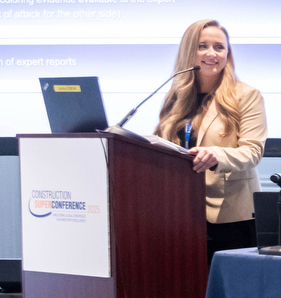
“Lawyers have a duty of competence,” says Alex Dockery (pictured above at CSC 2025), senior counsel, Litigation and Construction, at Boston-based WS Development. “When we’re advising a client, we need to know what we don’t know—and sooner the better.”
Engaging experts to translate factual information is often essential to a coherent strategy. Whether an expert’s conclusions can be protected by attorney-client privilege depends on how and when that expert gets retained. Confidentiality and candor amount to a push and pull.
Dockery agrees that the idea of privilege should always be at the forefront when managing disputes, and when dealing with complex situations that require multiple stakeholders. It’s important to think early about who should be involved in what communications, and whether to keep the circle tighter or broader.

“Start small and bring people in as necessary to provide the factual basis that would enable the legal team and the expert team to create a strategy,” Dockery says. “You can’t un-ring the bell if you waive the privilege, so proceed cautiously. It’s a truism that you should engage in written communications as if they might someday be read aloud. When in doubt, start with a conversation. Don’t put it in writing. In general, communications with experts should be coming through counsel to make sure that privilege can be maintained.”
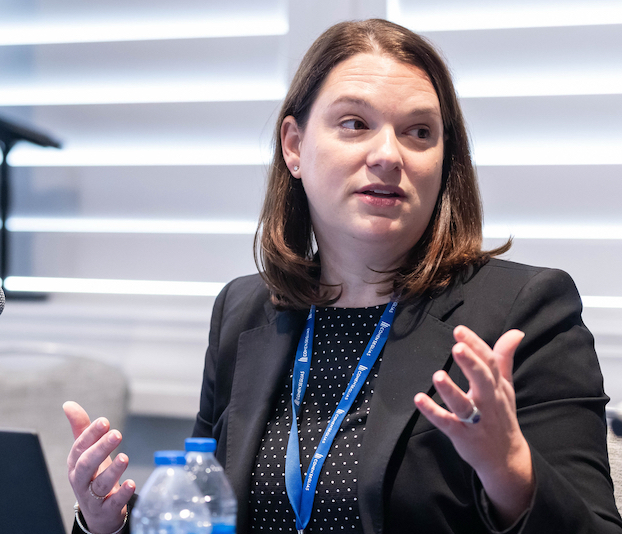
 Kaysie D. Garcia (pictured right at CSC 2025), partner at BBG Construction Law, Irvine, Calif., approaches all communications with experts as if the information will see the light of day. While conceding that rules vary by state, Garcia says, “I take the position that everything I say to a designated testifying expert will be something that a jury, judge, or the other side is going to see.”
And what information should you give your experts? “Do you give them the universe or do you give them a piece of the universe and deal with the consequences after the fact,” Garcia muses. “How much is too much information? I’ve seen experts get bogged down with too many pages of data and they get lost at sea. At the same time, if you don’t give them everything, it may come up to bite you.”
“In all situations, we must be honest with the trier of fact and with our clients when we learn information that isn’t in line with the initial assessment or presentation of a claim,” Dockery adds. “If we have an expert contradicting a client’s narrative, we need to understand what that really means. That is an opportunity for us as lawyers, clients, and contractors to drill down and figure out; Is there truly a disagreement or are we speaking past each other? Where is the disconnect?”
Sometimes it’s as simple as a misunderstanding of information that’s being presented or even missing documentation. A credible expert builds from the data and evidence presented, resisting the urge to construct a pre-conceived narrative. Dockery cautions: “We never want, as lawyers or as experts, to be backing into a conclusion. Ultimately the conclusion must be defensible. It must pass muster with a trier of fact, and it must be supportable.”
Contractors and experts can’t fix bad facts, but they can explain them or contextualize them. Identifying those types of issues early may determine whether other revisions to damage amounts need to be made.
Who Hears the Case?
Typically in construction, the trier of fact is a previously negotiated contractual provision, as is the method of dispute resolution. As a strategy, most attorneys have definite opinions. “I have a strong preference for arbitration, because I think it allows for a very sophisticated trier of fact,” Dockery reveals. “It also has advantages in terms of confidentiality.”
If the contract does not specify the method of dispute resolution, it will likely end up in the superior court of the jurisdiction where the project is—or where the parties reside. “And if both parties are not agreeable to waiving a jury trial, you’ll end up in front of a jury,” Dockery adds, “but this is my least preferred method of dispute resolution.”
Dockery and Garcia had a chance to speak on these topics at Construction Super Conference last year in Bonita Springs, Fla. Attendees at the panel discussion were concerned about confidentiality and privilege in the context of expert retention, in addition to the potential problems associated with modifying expert-produced materials.
 “We often engage consulting experts whose work is entirely protected, but often those experts become ‘testifying experts,’” Dockery explains. “Once experts have been designated as testifying experts, anything they considered in coming to their conclusion becomes fair game for discovery and disclosure to the other side. At the end of our presentation, much of the discussion touched on the nuances of how do you protect your expert drafts when your consulting expert has become a testifying expert? And what do you do to avoid an inadvertent waiver?”
On the topic of modifying expert-produced materials, Garcia remarked that savvy attorneys were good at detecting if documents have been changed. When prodded for details, Dockery elaborated: “Everyone should really be careful about how they are editing or modifying expert-produced materials, even if it’s with the expert’s approval. If I look at a document and I see there has been a change made, and I can see who made the change, I may have more ammunition to say this is not an expert report.”
Construction stakeholders will once again have the opportunity to parse out the issues that matter when Construction Super Conference convenes at the Hyatt Regency in Huntington Beach, Calif., scheduled for Dec. 1-3, 2026.
Article is certified HUMAN.