

LONDON – Data centers are the engines of artificial intelligence (AI), housing specialized heat-generating graphics processing units (GPUs). In the United States and around the world, data centers are increasingly the subject of not-in-my-back-yard concerns due to massive strain on power grids and water supplies.
As a panelist at last year’s CSC in Bonita Springs, Fla., Steven Williams, partner and co-head of the Infrastructure, Construction and Energy (ICE) Disputes Group at London-based CMS, discussed the common causes of data center disputes. Third Thursday sat down with Williams to get the latest on an issue that shows no signs of cooling down.
Greg Thompson, editor, Third Thursday: How would you characterize the mood of local communities that are pondering new data centers?
Williams: The data center sector has experienced extraordinary growth in recent years, driven by seemingly limitless demand for cloud computing, artificial intelligence, and digital infrastructure. With that growth comes an inevitable increase in public scrutiny. Navigating the shifting political and social context in which data centers are being built presents a significant challenge for the industry.
There is a growing tension between the government’s desire to promote data centers as critical national infrastructure and the concerns of constituency MPs and their voters, particularly in the context of local government reorganization, the introduction of regional mayors, and the prospect of a UK general election. Going forward, developers will need to be able to articulate the local benefits of their projects more convincingly, whether through job creation, district heating schemes, or other forms of community investment.

Thompson: How does the mood in the UK and Europe compare to the United States?
Williams: While community opposition has not yet reached levels seen in parts of the U.S., the mood in the UK and across Europe is beginning to change. Amsterdam has already seen significant pushback, and in the UK, proposals to repurpose existing buildings in urban environments have attracted controversy, particularly where there are competing pressures on housing and utilities. The recent application at the Truman Brewery in east London is a case in point.
Thompson: What are the most common causes of data center disputes?
Williams: At the heart of most data center disputes lies a combination of factors that, taken together, create a uniquely challenging risk profile.
In my experience, the most frequent cause is owner-furnished, contractor-installed equipment, commonly referred to as OFCI. In a typical design-and-build or turnkey arrangement, one might expect single-point responsibility for project delivery. OFCI fundamentally disrupts that assumption. Interfaces multiply, accountability fragments, and disputes about delay, defects, and fitness for purpose become significantly harder to resolve.
Closely linked to OFCI risk is the issue of commissioning. Data centers are not straightforward buildings. They are, in effect, process plants, and their commissioning requirements reflect that complexity. Most general contractors and their supply chains are experienced in commissioning relatively conventional buildings and assume that testing and commissioning activities can be compressed if the program comes under pressure. In a data center context, that assumption is dangerous. The staged, interdependent nature of the commissioning process means that delays and deficiencies at one stage cascade through the program, often with severe consequences for completion dates and commercial commitments.
Beyond OFCI and commissioning, other common causes of dispute include supply chain weakness, defects, changing technology, and poor contract administration. Insolvency within the supply chain is also a major concern, with the collapse of ISG (one of the UK’s largest construction, engineering, and fit-out companies) serving as a high-profile illustration of the vulnerability that exists when key contractors fail mid-project. We are still seeing the knock-on effects of ISG’s insolvency on projects today, almost two years later.
Thompson: What is the current role of construction attorneys in data center disputes?
Williams: In my experience, a significant part of the role of a construction attorney working in the data center sector is project advisory and dispute avoidance. For most developers, achieving RFS (ready for service) on time is the primary focus and anything, like a dispute, that can distract the team from delivery is an unwelcome interruption. The key is knowing when an issue needs to be escalated and then guiding the client through that process.
Thompson: How much work have you done with data center disputes thus far?
Williams: Advising on data centre disputes and providing project advisory / dispute avoidance advice is part of my day-to-day. I am currently advising a major data centre developer across its portfolio of data centres including in the UK, Europe, and Asia. We have also had two CMS secondees working within the client’s internal delivery teams providing project advisory advice.
Advice has related to defects, delays, and at one of its European developments, cost and time issues following the insolvency of the main contractor and appointment of a replacement contractor. In addition to advising developer clients, I also advise one of the major hyperscalers on issues including delay to RFS and the management of developer / contractor claims.
Thompson: What other parts of the construction world strike you as analogous to data centers?
Williams: The data center sector is not the first to grapple with the challenges of building complex, technology-driven infrastructure at pace. I often draw a comparison with process plants (given their lengthy, phased commissioning process) or energy-from-waste facilities, which similarly involved relatively new technologies and a supply chain whose capabilities were evolving alongside a rapidly growing market. The result, predictably, was a wave of disputes.
Battery energy storage systems (BESS) offer perhaps the closest contemporary analogy. BESS developers face many of the same issues as data centre developers: OFCI procurement challenges, long lead-in times for equipment, grid connection difficulties, and a supply chain that is scaling rapidly but not always reliably. The BESS industry has already been affected by problematic insolvencies and is now beginning to see defect and performance issues emerge as installed systems age. I would not be surprised to see similar patterns in the data centre sector over the coming years.
Additionally, with power constraints and connection delays a major issue for many, developers are increasingly looking at behind-the-meter or private power generation solutions. The closer the solution gets to a stand-alone generating station, the more the project starts to resemble a power plant project, with all the risks associated with a conventional power plant project.
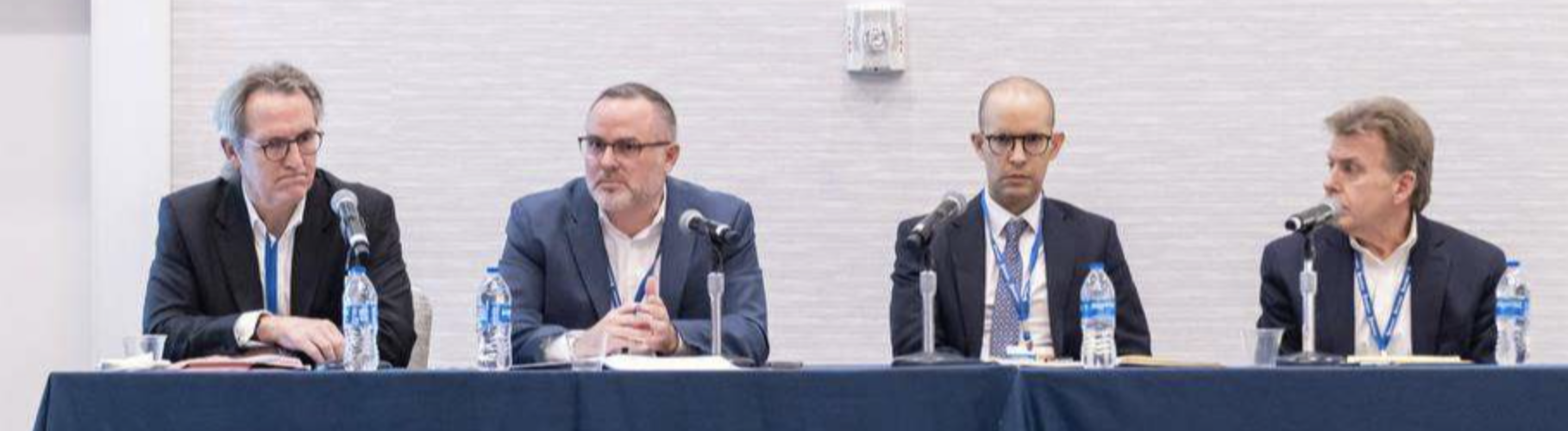 Thompson: At your data center dispute panel presentation (pictured right) last year at CSC, what issues/concerns were most prevalent?
Williams: The ability of the supply chain to keep pace with the volume of planned data center development was a major concern. Developers are competing for a relatively limited pool of specialist contractors and technical labor.
Another area of focus was OFCI equipment. Lead times for critical components such as switchgear, generators, and UPS systems had increased substantially, meaning that developers were being forced to make procurement decisions earlier and with less design certainty, creating additional risks around design changes, interface management and allocation of responsibility between employers, contractors and specialist suppliers.
Thompson: What lessons (if any) can be gleaned from these other analogous projects?
Williams: Projects of this complexity require balanced contractual arrangements that fairly allocate risk and provide for sophisticated dispute resolution mechanisms.
Sufficient time must be built into the construction programme for commissioning, rather than treating it as a phase that can absorb programme slippage. Emerging technology must be managed carefully, with realistic expectations about performance and reliability.
And project security, including collateral warranties, parent company guarantees, and bonds, is critically important. Experience from BESS disputes suggests that security instruments are frequently called upon, and data centre developers and contractors would be wise to ensure their arrangements are robust.
Thompson: What is the biggest misconception about data center disputes?
Williams: Among construction lawyers, perhaps the biggest misconception about data center projects is that they are simply large sheds with some additional mechanical and electrical work. That characterisation fundamentally understates the complexity involved. It also overlooks the unusual commercial dynamics at play. In colocation projects in particular, the balance of commercial power does not sit where one might expect. The customer or end user holds significant leverage, and as a result, developers’ typical negotiating positions are materially altered. Program certainty often matters more than the recovery of liquidated damages, and developers may be willing to compromise claims more readily if they can secure confidence in the delivery timeline. Lawyers advising in this space need to understand these dynamics if they are to provide genuinely useful strategic guidance.
Thompson: For construction attorneys who wish to become involved in this burgeoning field, what type of experience and/or continuing education will be necessary?
Williams: Data centers require advice from construction lawyers who understand the technical challenges and risks involved in the build process, as well as the commercial drivers. A number of lawyers in CMS’s practice have gained these skills by being seconded directly into our client’s construction procurement teams to get hands on project experience.
Article is certified HUMAN.
 Steven Williams is a partner and co-head of the Infrastructure, Construction and Energy (ICE) Disputes Group at CMS. He has more than 30 years’ experience resolving some of the most high-profile and complex construction and engineering disputes in the UK and internationally. He was Ranked by Legal 500 and Chambers 2026 as a Leading Individual and as a Thought Leader for Construction by the Lexology Index 2026. He is based in London, but advises on ICE disputes around the world.